
Scandinavian Living Room Design Ideas
By Thanos KazakisMagic Room founderUpdated
A Scandinavian living room earns its warmth through the combination of light wood, layered textiles, and multiple controlled light sources rather than any single dominant piece. The style is genuinely liveable because it was developed for long winters spent predominantly indoors, and its emphasis on cosy comfort over showcase presentation suits the functional demands of a daily living space.
See the transformation
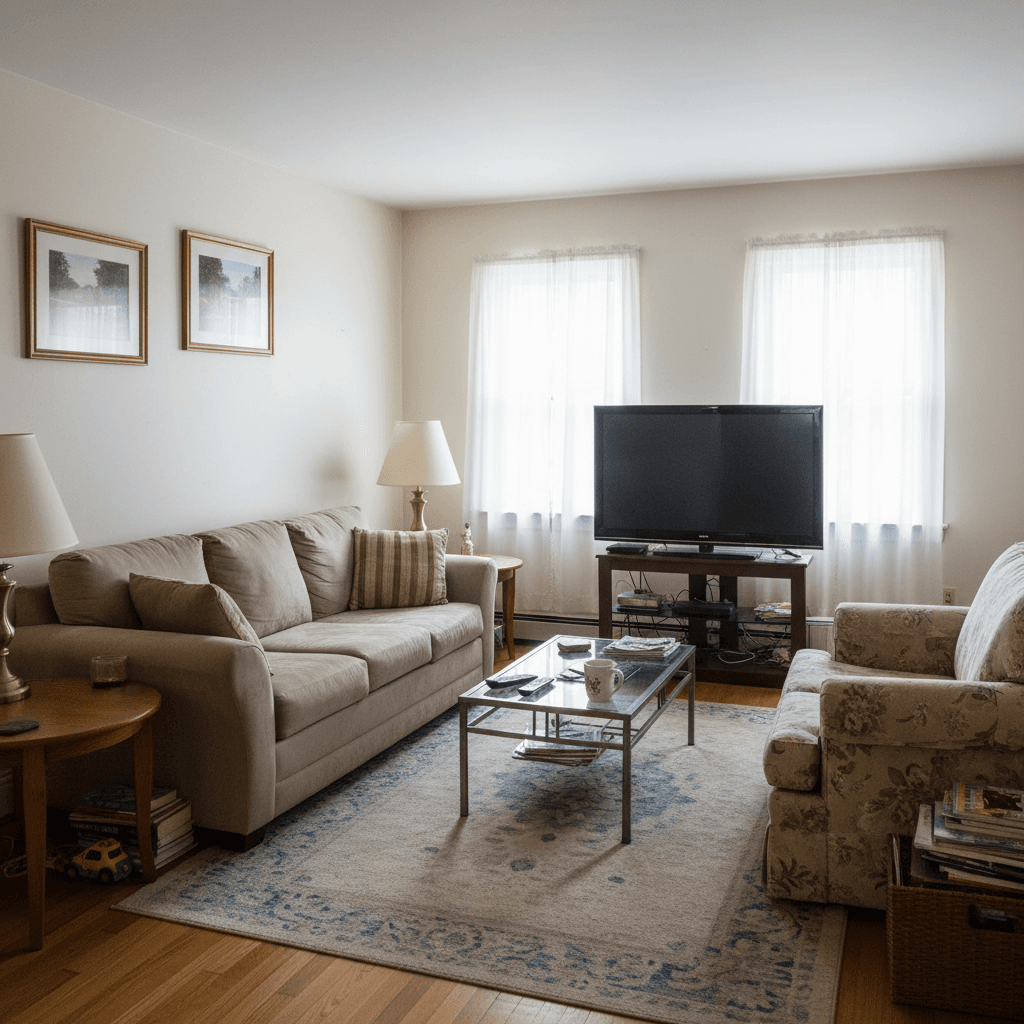
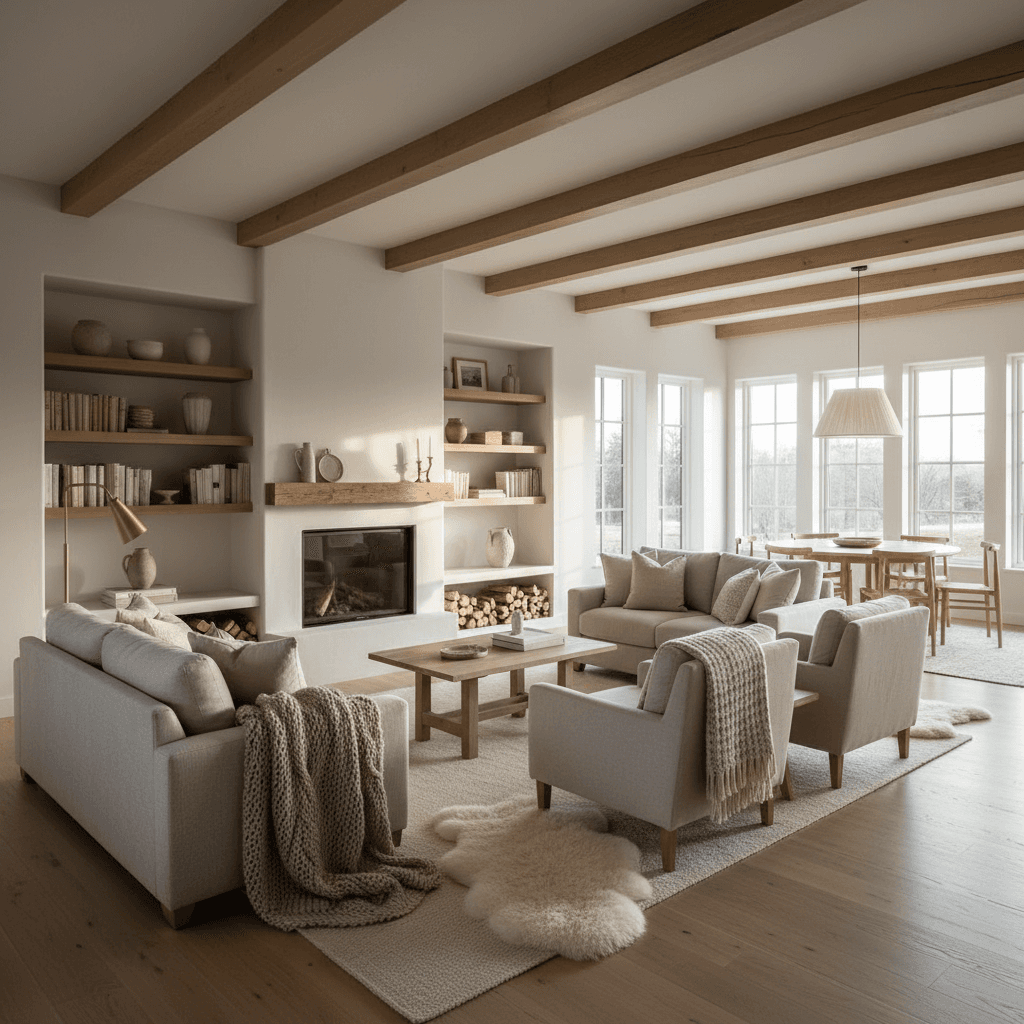
AI-generated scandinavian living room redesign from a single photo
How to get Scandinavian Living Room designs
1. Upload your photo
Take a photo of your room in good daylight and upload it directly from your phone or computer. No account required to try.
2. Select style and room type
Choose your design theme and confirm the room type. Add any specific details or requirements in the optional text field.
3. Download your designs
The AI generates your redesigned room in 30 to 60 seconds. Review the result, and download or share as needed.
Scandinavian design principles
Scandinavian design emerged from a climate where winters are long and daylight is scarce, so rooms were engineered to maximise warmth and comfort without sacrificing practicality. Light woods, wool textiles, candlelight, and handcrafted objects give the style a human quality that purely minimal approaches can lack.
Layer light sources strategically
Scandinavian interiors rarely rely on a single overhead fixture. Floor lamps, table lamps, candles, and under-cabinet strips create pools of warm light at different heights. This layered approach makes rooms feel cocooning in the evenings without the harshness of central lighting alone.
Choose light woods over dark ones
Pine, birch, and oak in lighter finishes reflect more of the available natural light and prevent the heavy quality that characterises other traditional styles. When in doubt, go lighter — you can always add a darker piece as a contrast accent later.
Introduce the concept of hygge through textiles
The Danish concept of hygge — a feeling of cosy contentment — is achieved largely through textiles. Chunky knit throws, sheepskin rugs, linen curtains, and wool cushions make a room feel safe and inhabited rather than styled. Layer multiple textures rather than relying on a single statement piece.
Keep decoration functional
Scandinavian homes decorate with objects that do something — a ceramic mug on a shelf, a wooden tray holding candles, a stack of books used rather than arranged. This prevents the over-styled look that makes rooms feel like showrooms rather than places people actually live.
Living Room design considerations
The living room is typically the room in a home that does the most social work — hosting guests, accommodating family life, and providing daily rest — which means its design must balance multiple, sometimes conflicting, demands simultaneously.
Traffic flow and furniture arrangement
Before selecting any furniture, mark out the room's natural pathways on a floor plan. Entrances, exits, connections to adjacent rooms, and the primary seating orientation all create movement lines that furniture should accommodate rather than block. Allow at least 90cm of clear walking space on main routes.
Acoustic comfort alongside visual appeal
Hard-surfaced rooms — tiled floors, plaster walls, minimal textiles — create echo and reflected sound that makes conversation tiring and television difficult to hear clearly. Rugs, upholstered furniture, curtains, and bookshelves all absorb sound energy and make a room significantly more comfortable to spend time in.
Lighting for different activities and times of day
A living room used for watching films in the evening, reading in the afternoon, and hosting guests needs different lighting for each activity. Installing separate switches or dimmers for overhead, floor, and table lamps gives you control over the room's atmosphere without requiring structural changes.
What separates a Scandinavian living room from a generally minimal one
The two styles get conflated constantly, and the confusion produces rooms that are merely empty. Minimalism is a subtraction discipline: the goal is fewer objects. Scandinavian design is a warmth-under-constraint discipline that emerged from a specific problem — long, dark winters and small urban apartments — and its rules exist to solve that problem rather than to achieve visual purity.
The practical consequence is that a Scandinavian living room is allowed, and in fact required, to have soft things in it. Wool throws, sheepskin, layered textiles and visible timber grain are not decoration added on top of a minimal room; they are the point. A room with white walls, a grey sofa and nothing else is minimal. Add pale oak, a wool throw, two plants and a warm-toned pendant and it becomes Scandinavian.
- Light woods with visible grain — pale oak, ash, birch, pine. Walnut and wenge push the room toward mid-century modern instead.
- Walls in warm white rather than cool white. Cool white plus grey furniture is the single most common way a Scandinavian living room ends up feeling clinical.
- Layered lighting at multiple heights — a pendant, a floor lamp, and at least one low light source. Scandinavian interiors almost never rely on a single ceiling fixture.
- Natural-fibre textiles: wool, linen, cotton, sheepskin. The tactile contrast against hard timber surfaces is doing most of the warmth work.
- Two to four plants at different heights. Enough to add living texture, not enough to read as bohemian.
- One muted accent colour at most — dusty blue, sage, terracotta or mustard, used across two or three small items.
Scandinavian living room ideas by room size
The style scales in a specific direction: the smaller the room, the more strictly the palette has to hold, and the more the warmth has to come from texture rather than from objects.
In a small living room (under 15 m²) choose a sofa with visible legs so floor shows underneath, keep the rug large enough to sit under the front legs of the furniture rather than floating in the middle, and use wall-mounted shelving instead of a freestanding unit. Wall colour stays warm white throughout — an accent wall in a small Scandinavian room fights the light-maximising logic that the style is built on.
In a larger room the risk inverts: the space becomes sparse and cold rather than cosy. The remedy is zoning rather than adding objects — a rug that defines the seating group, a reading chair with its own floor lamp in a corner, and a second textile layer on the sofa. A large Scandinavian living room needs more textile mass than a small one, not more furniture.
What AI gets wrong on Scandinavian living rooms
The dominant failure mode is that the model reads "Scandinavian" as "white and grey minimal" and strips out exactly the warmth that distinguishes the style. Outputs come back with a cool-white envelope, a grey sofa, no visible timber grain and no textiles — technically clean, and indistinguishable from a stock minimal render.
The second failure is wood tone. Left unspecified, models default to a mid-brown that reads as generic contemporary rather than the pale oak or ash the style depends on.
Naming the warmth explicitly fixes both. A prompt like "Scandinavian living room, warm white walls, pale oak flooring and furniture, wool throw and linen cushions, layered lighting with floor lamp, two plants" reliably produces the correct register on the first attempt, where "Scandinavian living room" alone does not. Specifying the wood species and the wall temperature is worth more than any other instruction you can add.
Frequently asked questions
Other styles for your Living Room
Art Deco Living Room Design Ideas
Glamour, geometry, and gold — the roaring twenties reimagined
Bohemian Living Room Design Ideas
Collected over time, layered with intention, unapologetically individual
Coastal Living Room Design Ideas
Breezy, light-filled spaces that bring the ocean indoors
Industrial Living Room Design Ideas
Raw materials, honest structure, urban character
Japandi Living Room Design Ideas
Wabi-sabi meets hygge — imperfect simplicity
Luxury Living Room Design Ideas
Exceptional materials, expert craft, enduring quality
Mediterranean Living Room Design Ideas
Sun-warmed, textured, and alive with colour and light
Scandinavian Living Room guides worth reading
Practical write-ups that go deeper than a single living room page — how to photograph the room, how to pick a style, and what AI redesign actually changes.
Redesign Your Living Room with AI: 7 Steps (2026 Guide)
AI room design tools have made it practical to visualise a completely different living room before spending anything on furniture
How AI Interior Design Tools Actually Work in 2026
Not all AI room design tools work the same way. Understanding the difference between diffusion models and multimodal models explai
Scandinavian Design: 12 Ideas for Small Spaces (2026)
Scandinavian design was developed in countries where domestic spaces are relatively small and daylight is seasonal. Its principles
How to Choose an Interior Design Style: 6 Quick Tests
Most people choose an interior design style based on how it looks in photography. A better approach starts with how you actually l
Before you pick an AI interior design tool
Magic Room is not the only way to generate these designs. Here is how it compares to the tools most people evaluate alongside it.
best RoomGPT alternatives for AI interior design
All four tools compared on AI model, photo retention, pricing model and output quality.
DecorAI alternative
Why people switch from DecorAI, and what changes when they do.
Reimagine Home alternative
Why people switch from Reimagine Home, and what changes when they do.
Magic Room vs DecorAI
Side-by-side on AI model, photo privacy, pricing and output quality.